


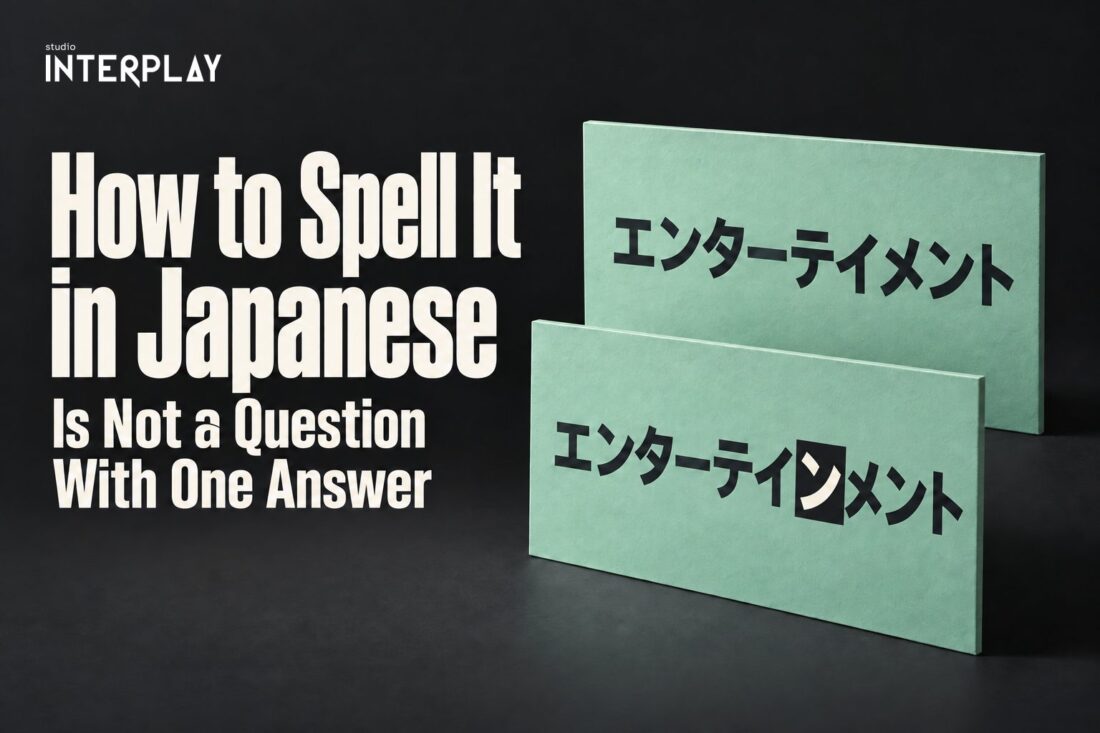
How to Spell It in Japanese Is Not a Question With One Answer
At some point a brand entering Japan has to write its own name in Japanese, and then keep writing it that way. On the packaging, in the app, in the press release, in the search ads. One spelling, used everywhere, because inconsistency in a brand’s own name looks like carelessness.
It is a small decision that feels like it should have a right answer — a spelling that is simply correct, which somebody could look up.
Japan’s Agency for Cultural Affairs runs an annual survey on the Japanese language, and one of its questions is close enough to be worth reading before that decision gets made.
One word, two spellings, five to one
The 2024 survey gave respondents fifteen loanwords, each written two ways, and asked which they would use. One of the pairs was the Japanese rendering of “entertainment”:
| Would use | ||
|---|---|---|
| エンターテイメント | 76.6% | |
| エンターテインメント | 15.8% |
The second spelling is the one that keeps the “n” of the English word. It loses, roughly five to one.
And the survey is careful to say that this is not a finding about correctness. The question carries its own instruction, printed above it in the published tables (our translation, here and throughout):
What this survey is asking is not which is correct. Please answer with whichever you think.
So the numbers are not a verdict. They are a report on what people would write, gathered from people who were told explicitly that being right was not the point.
Fourteen more words, and no single pattern
If that ratio were unusual, it would be a curiosity about one word. It is not unusual, and the ratios do not settle anywhere.
| Pair (as asked) | First | Second |
|---|---|---|
| エンゼル / エンジェル | 21.1% | 64.2% |
| フィルム / フイルム | 78.6% | 13.8% |
| ウェア / ウエア | 67.0% | 25.5% |
| サンドイッチ / サンドウィッチ | 47.6% | 41.1% |
| クォーツ / クオーツ | 60.5% | 31.1% |
| ライプチヒ / ライプツィヒ | 46.0% | 37.6% |
| ヒンズー / ヒンドゥー | 40.4% | 45.7% |
| ボーカル / ヴォーカル | 63.2% | 19.2% |
| テューバ / チューバ | 4.0% | 89.9% |
| エンターテイメント / エンターテインメント | 76.6% | 15.8% |
| スパゲッティ / スパゲティ | 48.3% | 38.9% |
| バースデー / バースデイ | 67.7% | 18.2% |
| セキュリティー / セキュリティ | 34.2% | 53.5% |
| リタイヤ / リタイア | 26.9% | 64.5% |
| エクスプレス / エキスプレス | 68.1% | 20.4% |
Two rows are near-unanimous: 89.9% for one tuba spelling, 78.6% for one film spelling. The closest row is the Hindu pair, at 40.4 against 45.7 — a gap of five points, and one of the rows where the second spelling listed is the one in front. Sandwich follows at 47.6 against 41.1. The rest sit somewhere between.
There is no rule here that would let anyone predict the next word. Whether the more phonetically faithful spelling wins or loses varies from row to row.
The column that is easy to miss
Those two columns do not add to a hundred, and the remainder is the part worth stopping on. The published tables carry four options, not two.
| Range across the fifteen words | |
|---|---|
| Would use the first | 4.0% – 78.6% |
| Would use the second | 13.8% – 89.9% |
| Uses either, depending on the case | 3.8% – 15.7% |
| No answer | 1.3% – 4.8% |
Between roughly one in twenty-five and one in six of the respondents said they use both, depending on the situation. For the two vocal spellings it was 15.7%. For angel, 13.0%. For birthday, 12.3%.
That is a different thing from being on the losing side of a split. The option is not “has not decided” — it is “uses either, depending on the case.” These are readers who switch: one spelling in one context, the other in another, and both of them theirs.
Which is where the asymmetry sits. A brand cannot switch. The name on the packaging has to be the name in the app, the press release and the search ads, because a company that spells itself two ways looks careless. A reader operating both spellings is not being careless — they are doing something the brand is not permitted to do.
The same word splits differently by age
The published summary reports the age pattern for each pair, and the patterns are not the same from word to word.
For the entertainment pair, the summary states that the share choosing エンターテイメント tends to rise with age, and the share choosing エンターテインメント tends to fall with it. For the angel pair, it reports something different in shape: エンゼル is higher among respondents in their sixties and above, and エンジェル lower in that group, without a gradient across the middle.
So the two-way split is not one population divided once. For a given word, which spelling leads can depend on who is being counted, and the direction is not the same for every word.
A brand picking a spelling is therefore picking, in part, an audience it matches — without a rule that would tell it which way the match runs for its own name. The summary describes these as tendencies, and they are worth carrying as tendencies.
Who was asked
The survey is worth taking seriously and worth reading precisely.
It was run by the Agency for Cultural Affairs’ Japanese Language Division, fielded by a research company between 14 January and 4 March 2025, by post, to individuals aged 16 and over across Japan. Of 6,000 people approached, 3,498 responded — a rate of 58.3%.
One caveat travels with it, and the survey prints it:
Since fiscal 2020 the survey has been conducted by mail. In fiscal 2019 and earlier it was conducted by face-to-face interview. Because the survey method differs, results from fiscal 2019 and earlier are reference values, and care is required in comparing them.
So this is a single year read on its own, not a trend. Nothing above is a claim that anything has changed.
The reaction to the words themselves is also divided
The same survey asks a broader question: how people feel about using loanwords in daily speech and writing at all.
| Finds it rather favorable | 21.8% |
| Finds it rather unfavorable | 28.8% |
| Feels nothing in particular | 48.3% |
Nearly half register no reaction. The rest divide, with slightly more on the unfavorable side than the favorable one.
The survey’s summary is precise about which of these is which. The favorable share is described as tending to fall as age rises. The other two are not put that way: the unfavorable share is simply reported as higher among respondents in their sixties and above, and the “nothing in particular” share as higher among those in their twenties to forties. One tendency and two observations about particular age bands — worth carrying in that shape rather than flattened into three of the same thing.
What this survey does not say about a brand name
It is a survey about ordinary words, and the distance between that and a brand is the thing to be exact about.
It asked nothing about brands. Not about brand names, not about taglines, not about advertising copy, not about whether a spelling affects what anyone buys or thinks of a company. Every figure above is about words like sandwich and birthday.
So it cannot be turned around into a prediction. It does not support “Japanese consumers will read your katakana this way,” and no amount of arithmetic on these tables will produce that sentence.
What it does establish is narrower and still useful: for ordinary words, with no brand attached and nothing at stake, the answers do not converge. There is no reason to expect a brand’s own name — newer, less familiar, and carrying an English original that people may or may not know — to behave more consistently than “sandwich.”
The decision does not resolve itself
Which puts the decision back where it started, but with the shape of it visible.
There is no register to consult that will settle the spelling, because the body best placed to run that register asked the question and specifically declined to ask which answer was right. The distribution is what exists. It varies by word, it varies by age, and a share of the population sits outside the two-way split entirely.
That means the spelling of a name in Japanese is a decision to be made deliberately and then held — chosen for reasons the company can state, documented so that it survives staff changes and agency changes, and applied consistently even though the audience will not be consistent in return. It is not a fact to be discovered, and waiting for one to emerge is waiting for something the data gives no sign of.
The document that usually carries a decision like this one — the brand guideline — has its own trouble surviving the trip, which we looked at separately. And settling a spelling belongs with the other things worth fixing before a launch calendar hardens, which is where we tend to start.
Source: 文化庁「国語に関する世論調査」令和6年度 / Public Opinion Survey on the Japanese Language, FY2024, Agency for Cultural Affairs. Figures from the published summary and from the published tabulation tables (questions 9 and 12). https://www.bunka.go.jp/tokei_hakusho_shuppan/tokeichosa/kokugo_yoronchosa/index.html — the survey is published in Japanese only, and every passage rendered above was translated by us.